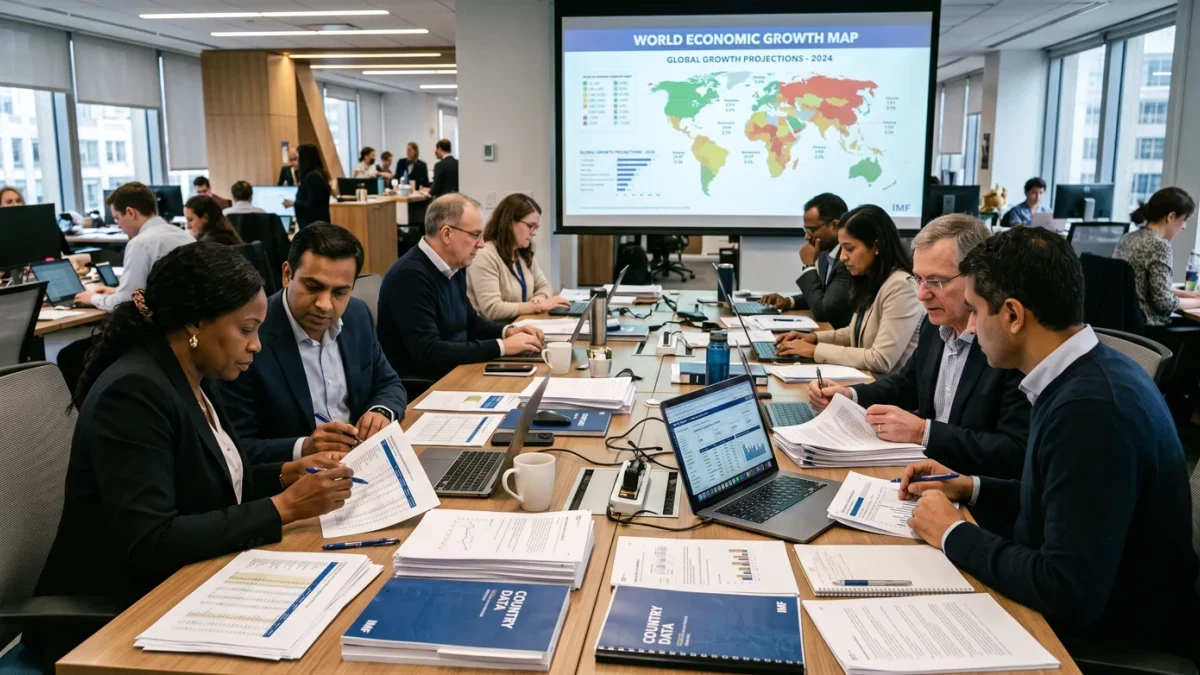
The International Monetary Fund raised its growth forecast for the Middle East and Central Asia region in its January 2026 World Economic Outlook update, published January 19. The region is projected to grow 3.9 percent in 2026 and 4.0 percent in 2027, an acceleration from 3.7 percent in 2025, against a global economy the Fund expects to expand 3.3 percent this year and 3.2 percent next.
The update, the Fund's first revision of the year following the October 2025 full Outlook, marked a modest upward tilt to the global forecast and a regional picture built on two engines: the continued expansion of Gulf non-oil economies and a grinding recovery in the region's importers and conflict-affected states. The Middle East and Central Asia grouping spans the GCC, North Africa, Iran and Afghanistan, and the Caucasus and Central Asia, and its aggregate improvement absorbs wide internal differences.
What the numbers say
The headline regional series shows 3.7 percent growth in 2025 rising to 3.9 percent in 2026 and 4.0 percent in 2027. Global growth of 3.3 percent for 2026, revised slightly up from the October 2025 WEO, remains below the historical average by the Fund's framing, with the update citing resilient activity in the United States and parts of Asia against continued drag from trade fragmentation. The Fund publishes the regional aggregate with subgroup breakdowns, oil exporters and importers, exporters again split between the GCC and other producers, that carry most of the analytical weight for MENA readers.
The Gulf's non-oil story
The Gulf contribution to the regional number rests on the divergence that has defined the GCC economy since 2021: oil GDP broadly flat under OPEC+ production management, and non-oil activity growing at rates in the four-to-five percent range in the strongest economies. Saudi Arabia's non-oil sector has expanded at rates near or above four percent in recent quarters as giga-project spending, tourism and entertainment investment feed through; the UAE's non-oil economy has run on similar momentum, with Dubai's property, logistics and services complex setting multi-year records; and Qatar and Oman have added steady gas-linked capacity growth. The Fund's regional updates through 2025 consistently identified this non-oil momentum as the region's main growth prop, and the January figures carry that assessment into 2026.
The importers and the stragglers
The other half of the regional aggregate is more mixed. Egypt's stabilization under its IMF program, the currency adjustments and the inflows that followed the 2024 Ras El Hekma investment, has produced a slow normalization path that the Fund has tracked program review by program review. Morocco's economy carries the twin exposures of agriculture and phosphate cycles, with drought years pulling growth below potential and good agricultural years restoring it. The conflict-affected economies, Sudan above all, remain deep in output collapse, and reconstruction economics in Gaza and Lebanon enter the aggregates only at the margins. Iran's trajectory, compressed by sanctions and energy constraints, continues to weigh on the grouping's average.
| Indicator | 2025 | 2026p | 2027p |
|---|---|---|---|
| Middle East and Central Asia growth | 3.7% | 3.9% | 4.0% |
| Global growth | 3.2% | 3.3% | 3.2% |
What the update does not settle
The January update is a nowcast-adjacent exercise, and the risks it flags travel with it. Oil prices under OPEC+ supply policy set the Gulf's fiscal arithmetic, and the Fund's commodity price assumptions feed directly into regional budget positions. Trade fragmentation, tariff escalation between major blocs and shipping disruption through the Red Sea corridor have all appeared in successive updates as the regional risk register; the January document's global revision upward does not remove them, and the Fund's standard formulation, that risks are broadly balanced but tilted to the downside for the region, has been a constant of the cycle. The next full reckoning comes with the April 2026 World Economic Outlook, the spring meetings' centerpiece.
Why it matters for the region's planners
For regional governments, the January update functions as the year's opening external benchmark: finance ministries calibrate budget assumptions against it, and sovereign credit analysts read the regional revisions for direction. A number at 3.9 rather than 3.6 changes little by itself; the composition underneath it, non-oil strength broad enough to lift the aggregate while oil output stays managed, is the signal that budgets and borrowing plans are built on. For the region's private sector, the Fund's endorsement of accelerating regional growth in an environment where global trade still drags is the macro backdrop against which the year's investment cases will be argued.
How to read an update like a regional analyst
The January document rewards a specific reading discipline. The global forecast sets the demand backdrop, and its direction, up or down from October, moves the region's exporters through the oil channel before any regional line is read. The regional aggregate's composition matters more than its level: the Fund's subgroup tables separate oil exporters from importers and the GCC from the wider group, and the spread between those lines is the year's distributional story. The fiscal and external balances annexes, where published, carry the budget math that the growth rates feed. And the risk paragraphs, usually compressed to a paragraph of standard language, are worth parsing word by word, because the Fund's drafting conventions signal real conviction through small phrases. Analysts then reconcile the update with the region's own numbers, the Gulf budget statements published in December, Egypt's program reviews, the high-frequency PMIs, to see where the Fund's map and the ground truth disagree, and the market's subsequent revisions usually start exactly at those joints.
For the structural side of the region's growth picture, read our explainer on how Gulf pension systems shape the region's labor economics, and browse the business and economy section for continuing coverage.