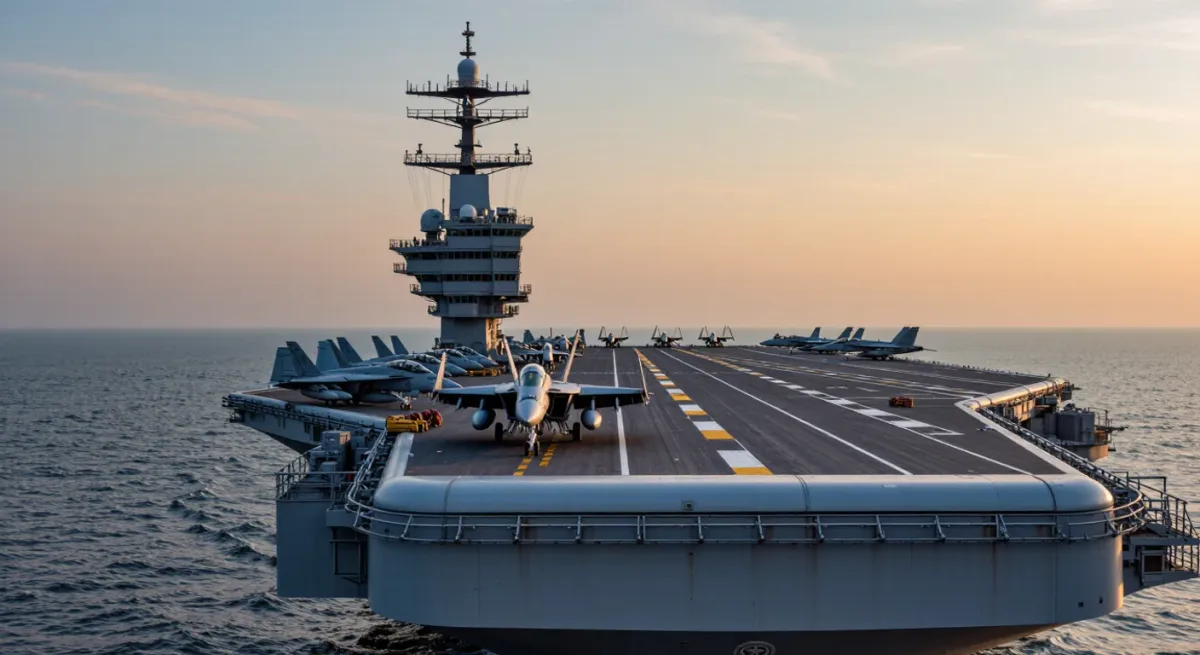
US President Donald Trump declared the Strait of Hormuz completely open and ready for business at the end of August, while stating that the naval blockade will remain in full force, a paired formulation recorded in the Guardian's running timeline of the war's attacks and price moves on August 28, 2026. The statement is the war's central ambiguity compressed into one sentence: the waterway is open, and it is blockaded, and both claims are policy.
The two halves of the formulation describe two different things, which is why the market, the shipping industry and the region's diplomats read it as continuity rather than change. Open refers to the passage Iran closed by declaration in February: with the late-July pause in strikes and Iran's restraint, the physical corridor is no longer under active attack, and some traffic, including the partial transits of the early-summer truce, has tested it. Blockade refers to the US naval posture around the strait and the Gulf, the enforcement layer assembled through the war to police Iran's shipping and interdict what Washington targets, and that layer, per the president's own statement, stays.
What the market did with the words
The oil market's reaction tracked the distinction. Prices, which had fallen more than 5 percent when the strike pause began in late July and settled into the high-eighties-to-nineties band the US Energy Information Administration forecasts for the second half of the year, treated the statement as a status-quo marker: no escalation to price, no reopening to discount. Shipping sources draw the same line: routine commercial transits through the strait remain a fraction of the pre-war norm, with tanker traffic still constrained by insurance, inspection regimes and the blockade's rules of engagement, whatever the corridor's nominal status.
| Claim | Refers to | Status |
|---|---|---|
| Completely open | Passage free of active attack | Strike pause holding |
| Blockade in full force | US naval enforcement posture | Continues by design |
The negotiation behind the formulation
The statement reads as a negotiating position in the diplomacy the pause was meant to enable. Iran's declared price for normalizing the strait has been the lifting of the naval posture; the US position, per the August formulation, is that the blockade is precisely the leverage that stays until Iran's broader concessions, on its nuclear program above all, are secured. Between the two sits the region's economy: the Gulf's export recovery, Asia's crude and LNG supply, and the insurance market's pricing of every transit through the world's most important chokepoint all wait on the gap between open and unblockaded narrowing into an actual agreement.
The region's read
Gulf states, whose exports the blockade-or-openness settlement governs, have continued their own hedge: the Saudi-led Red Sea coalition answers the western corridor's security with regional ownership, and the eastern corridor's normalization is being courted through the same multilateral channels. Asian importers, the customers whose refiners and LNG terminals hold the demand side, have pursued their own arrangements, including the India-Japan LNG stockpiling cooperation signed in July, treating the strait's status as a permanent contingency rather than a solvable dispute. The European gas market, entering winter with storage at its lowest in more than a decade, has the least room for the ambiguity to persist into the heating season, as our companion coverage of the storage numbers details.
Where this leaves the war's ledger
Six months in, the war's economic settlement remains exactly as partial as the strait's status: strikes paused, blockade enforced, prices elevated but off their peaks, shipping rerouted but tentatively returning where risk allows. The president's formulation, open and blockaded, is an honest description of that interim state, and its durability is the question the autumn's diplomacy, the UN General Assembly's season included, will have to answer. For the region's part, the reconstruction of what was destroyed, from Ras Laffan's trains to the Red Sea's insurance basis, has barely begun, and none of it starts at scale until the strait's two adjectives collapse into one.
Why words move tankers
The market's attention to presidential language is not theater; it is how chokepoint economics actually works. The strait's status is a function of three variables, Iran's closure posture, the US naval enforcement regime and the insurance market's reading of both, and the third variable prices the first two continuously through the quotes it publishes. A statement that holds the blockade in place tells underwriters the enforcement regime's risks, boardings, inspections, diversion orders, remain part of every transit's expected cost, and the quotes stay at levels that keep routine commerce marginal. A statement signaling release would let the same quotes unwind within days, and the tankers waiting at the anchorage would move before the diplomatic paper was signed. This is why the region's shipping desks parse the podium more closely than the foreign ministries: the strait's real status is written not in declarations but in the war-risk premium, and that number responds to language with a lag measured in hours. The August formulation, open and blockaded, has its price, and the market has set it.
The next markers are the transit count's weekly trend, the insurance market's month-end renewals and any language from Tehran that engages the blockade's reduction, each of which would carry more information than another press-conference formulation.
Until then, the formulation stands as the war's most quotable status line, one adjective for the water and one for the navy, and the market left to arbitrate the difference daily.
For the European consequence of that ambiguity, read our report on Europe's gas storage hitting a 13-year low, and browse the world news section for continuing coverage.