What is Yennayer? It is the Amazigh New Year, the agricultural-calendar new year celebrated across North Africa's Amazigh communities, observed between January 12 and 14 depending on the country. Algeria made January 12 a paid national holiday in 2018; Morocco declared January 14 a national holiday in 2023. The year that began in January 2026 is 2976 on the Amazigh calendar.
The date comes from the Julian calendar's new year and its associated agrarian cycle, which is why the celebration lands in deep January rather than at a solstice or equinox, and why the two states that gave it legal status each fixed a different day from within the same band. For Amazigh communities from the Rif to the Tuareg Sahel, Yennayer opens the farming year: it is the moment seed stock is audited, a ceremonial meal closes the old harvest, and household rituals predict the year's fortune. In 2026 the calendar turned to 2976, counted from the enthronement of the pharaoh Shoshenq I, a Libyan-origin ruler of ancient Egypt, in around 950 BC.
How the two national holidays were created
Algeria moved first. President Abdelaziz Bouteflika's decree of January 2018 made Yennayer a paid public holiday across the country, responding to decades of Amazigh cultural activism that had already secured recognition of Tamazight as a national language in 2002 and, in 2016, as an official one. The Algerian date is fixed at January 12.
Morocco followed in 2023, with the royal decision announced in May of that year making Yennayer a paid national holiday from January 2024 onward. Rabat fixed its observance at January 14, aligned with the calculation used in parts of the Moroccan south and the Souss rather than Algeria's date, and the first state observance drew large public festivals in Agadir and Rabat in January 2024. Morocco had recognized Tamazight as an official language in its 2011 constitution, and the holiday completed a decade-long sequence of institutional recognition.
| Country | Holiday date | Status since |
|---|---|---|
| Algeria | January 12 | Paid national holiday, 2018 |
| Morocco | January 14 | Paid national holiday, announced 2023 |
| Tunisia, Libya | Jan 12–14 locally | Cultural observance, no national holiday |
What the celebration actually involves
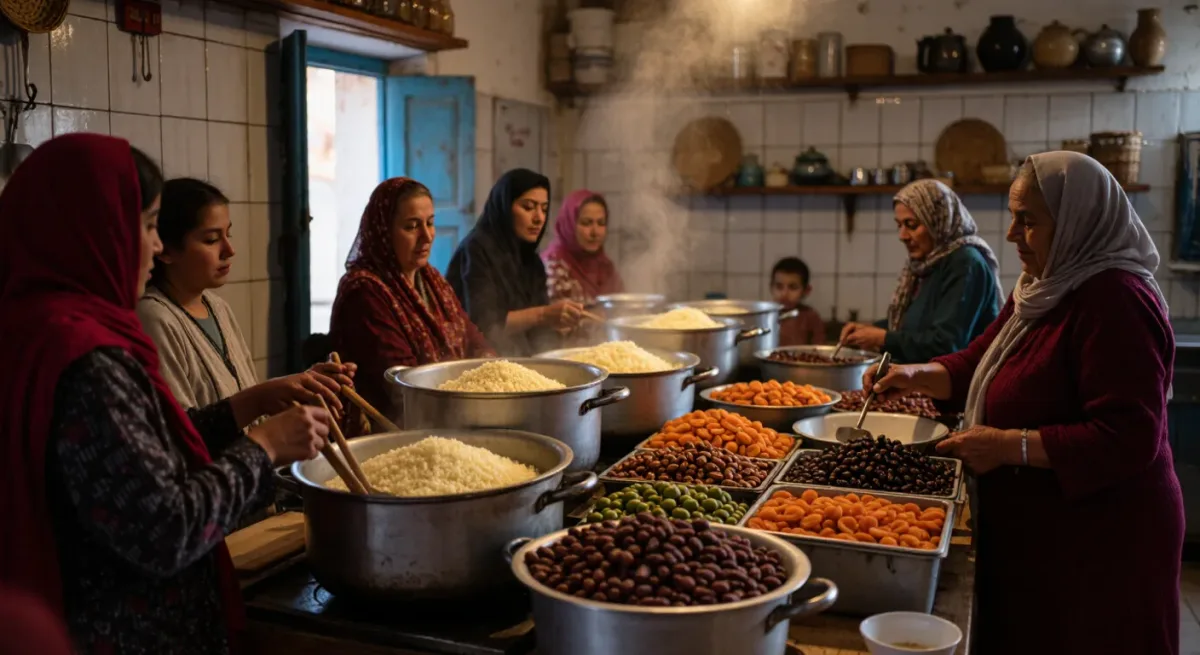
The through-line of Yennayer is the meal. In Algeria's Kabylie and Aurès and in Morocco's Souss and Atlas valleys, households prepare a ceremonial couscous or chickpea-and-winter-vegetable dish, often with dried meat preserved since autumn, and in many traditions a symbolic object, a date pit, a coin, is hidden in the serving so that whoever finds it reads luck for the year. Sweets and fruits are set out in numbers that vary by region, and children are given small gifts, a custom that has drawn comparisons to new-year gift traditions worldwide.
Beyond the table, the observance is public and performative. In the Kabylie region, town squares hold ahwach and other communal dances; in the Moroccan Souss, troupes stage tindδamt performances; in the Tuareg communities of the Sahel, the closest observances run into seasonal festival cycles tied to pastoral calendars rather than state holidays. Since the Algerian and Moroccan state recognitions, capital-city concerts and televised broadcasts have scaled the celebration upward, and the BBC's coverage of the 2026 new year described observances from Algiers to Agadir marking year 2976.
Why it matters beyond the calendar
Yennayer's route to state recognition tracks the broader arc of Amazigh cultural politics. The Amazigh, the indigenous non-Arab peoples of North Africa, spent the post-independence decades in tension with Arabizing state cultural policies. The 1980 Berber Spring in Kabylie, the creation of the Amazigh flag in the 1990s and the long campaign for Tamazight's official status culminated in the constitutional and calendar recognitions of the 2010s. Yennayer is the most visible annual expression of that settlement, and the fact that two neighboring states celebrate it two days apart is itself a readable detail: each government fixed the date that matched its domestic politics and its preferred cultural calculation.
The holiday also functions as a bridge to the diaspora. Amazigh communities in France, Spain, the Netherlands and Canada hold Yennayer events in the same January window, and the celebration has become one of the fixed dates of the Euro-Maghrebi cultural calendar, alongside film festivals and Tamazight-language media milestones.
Practical notes for the holiday
- In Algeria: January 12 is a day off for public and most private offices; expect closures and family gatherings, with public concerts in Kabylie cities such as Tizi Ouzou and Béjaïa.
- In Morocco: January 14 is the national holiday; the Agadir region hosts the largest public program, reflecting the Souss's Amazigh demographic weight.
- Elsewhere: Tunisian and Libyan Amazigh communities observe the date culturally, without a national holiday, so business runs as usual.
- Language: greetings in Tamazight, Assegas Amegaz, circulate widely in Algeria and Morocco on the day and are received well from outsiders.
How the date is calculated
The Amazigh calendar itself is a solar calendar aligned to the Julian year, which is why it runs a steady 13 days behind the Gregorian calendar's solstice math and why the new year lands reliably in mid-January. The epoch, 950 BC, corresponds to the reign of Shoshenq I, the Libyan-ancestry founder of Egypt's 22nd Dynasty, and the year number converts by adding 950 to the Gregorian year. The between-January-12-and-14 spread of observances reflects local Julian-calendar reckonings and pre-state traditions rather than astronomical disagreement: the agrarian marker that matters is the deep-winter threshold after which the farming year turns, and each region's calendar customs kept their own anchor. Since the states entered the calendar business, the official dates have fixed the holiday at January 12 in Algeria and January 14 in Morocco, with communities in Libya, Tunisia and the Tuareg Sahel observing on whichever of the three days their local tradition holds, and diaspora events in Europe and North America clustering across the whole window.
For more on how North Africa's calendars, workweeks and public holidays are structured across the region, read our companion explainer on how Ramadan changes working hours across MENA, or browse the society and culture section.