Bahrain's most distinctive heritage visit is a walk. The Pearling Path, inscribed by UNESCO in 2012 under the name Pearling, Testimony of an Island Economy, threads 3.5 kilometers through Muharraq, the island town just across the water from central Manama, linking the oyster-bed landing point on the shore to a chain of merchants' houses, mosques and shops that ran the Gulf's pre-oil economy. The trail is free to walk, waymarked end to end, and doable in half a day, with November to March the comfortable season for the whole country.
What the path actually is
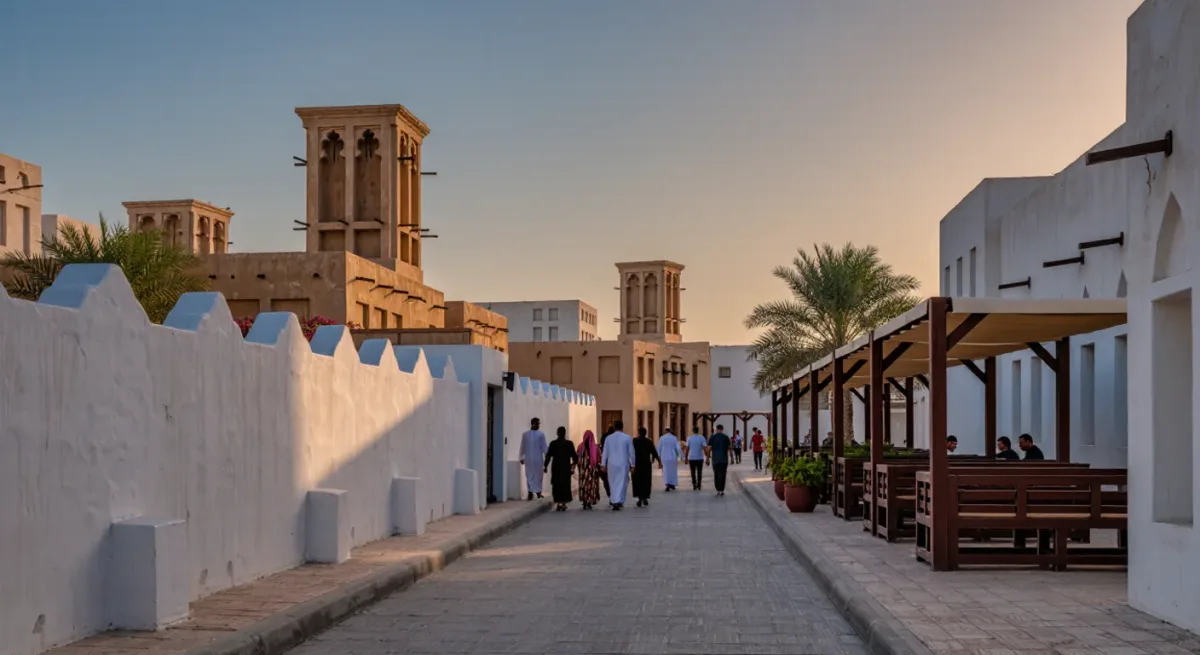
The UNESCO listing covers three elements: the oyster beds off the island's northern coast, the shoreline where the fleets landed at Bu Maher, and the urban sequence in Muharraq where the trade was financed, processed and lived in. The walk runs the third and part of the second. It starts at the Bu Maher fort and visitor center on the south shore of Muharraq, reached by a short causeway walk or the dedicated boat shuttle across from Manama's Bahrain National Museum, and runs north through the old town lanes past the Siyadi complex, the best-preserved merchants' residence, and the restored market buildings around Fakhri House and the sheikhs' houses, ending in the northern quarters where the diving captains lived.
Along the route, contemporary architecture houses the interpretation: the visitor center at Bu Maher holds the site museum, and several restorations, funded under the path's conservation program, explain the diving seasons, the financing structure of the dhows and the decline of the industry after Japanese cultured pearls collapsed prices in the 1930s. The path's public realm work, new squares and shaded lanes threaded through a living town, is itself the reason to walk it rather than drive past: Muharraq remains a working neighborhood of bakeries and majlis, not a gated heritage zone.
Doing the walk properly
- Start early: the full route with site entries runs three to four hours; begin by 9 a.m. and the museum stops fall in order.
- Direction: shore to town, Bu Maher to Siyadi, matches the historical logic of the oysters moving inland.
- Entries: the trail is open streets; the museum sites within charge small fees, typically a dinar or two.
- Navigation: the pearl-shell waymarkers and signage run continuously; offline maps are reliable in the lanes.
- Cafes: the coffee stops sit mostly at the Manama-end and around the Siyadi quarter; carry water in summer, when the walk should shift to early evening.
Pairing it with the rest of Bahrain
The Pearling Path explains the sea half of Bahraini heritage; a second half-day covers the land half. Qal'at al-Bahrain, the Portuguese-era fort on the northern coast whose tell beneath it holds 4,000 years of settlement including the Dilmun civilization, is the country's other UNESCO site, open grounds with a small site museum and the best late-afternoon light on the island. The Bahrain National Museum in Manama, charging around a dinar, is the Gulf's strongest national museum, with the Dilmun galleries and the burial-mound ecology displays doing the interpretive work. The burial mounds themselves, thousands of Dilmun-period tumuli across the island's northern half, received their own UNESCO inscription in 2019 and read best from the A'ali pottery district, where kilns cut into the mounds continue a living craft.
Manama's souq district, a short drive across the water, holds the gold souq and the fabric rows in a grid that still functions locally rather than purely for visitors. For contemporary Bahrain, the Bahrain International Circuit at Sakhir runs its Formula One grand prix in early spring, the region's longest-established race, with public track days and tours outside the race week; the King Fahd Causeway to Saudi Arabia sits at the island's western edge as a logistics fact rather than an attraction.
| Stop | Allow | Notes |
|---|---|---|
| Pearling Path, full route | 3–4 hrs | Free trail; site museums charge small fees |
| Bahrain National Museum | 2 hrs | ~1 BHD; boat link to Bu Maher |
| Qal'at al-Bahrain | 1–2 hrs | Open grounds; museum on site |
| A'ali burial mounds | 1 hr | UNESCO 2019; pottery kilns active |
| Manama souq | 2 hrs | Gold and fabric rows; evening hours |
Season and practical notes
Bahrain runs a Gulf coast calendar. November to March delivers days in the low twenties with cool evenings and the country's outdoor season, including the race weekend and the pearling-heritage events the site authority stages in winter. From May through September, humidity and heat push public life indoors and after dark; walking the Muharraq trail then wants an evening start around 5 p.m., when the lanes are busiest anyway. Alcohol is available in licensed hotels and clubs, the most permissive arrangement on the Arab side of the Gulf outside Dubai, and taxis and ride-hailing cover the Manama-Muharraq crossings cheaply. Direct flights connect Bahrain to most Gulf capitals and a spread of European and Asian hubs, and the airport sits on Muharraq itself, ten minutes from the trail's northern end.
Half-day and full-day sequences
For a half day focused on the path itself, start at the Bahrain National Museum for the historical grounding, take the museum's boat across to Bu Maher, and walk the trail north with the Siyadi complex as the turn-around point, finishing in a Muharraq cafe as the lanes light up. A full day adds Qal'at al-Bahrain on the northern coast in the late afternoon, when the fort grounds are coolest and the light is best on the sea-facing tell. Travelers with a second day should give it to the island's contemporary side, the Bahrain International Circuit's tours and the souq's gold quarter, or to the water: dive operators run reef and wreck trips year-round from the club coast north of Manama. The Ramadan and pearl-season calendars matter for events: the culture authority programs the trail's squares with performances through the winter season, and the pearling-diving demonstrations tied to the heritage calendar are worth timing a visit around when published.
For a Maghreb counterpart built on a walkable UNESCO-listed old quarter, see our Algiers Casbah and Tipasa guide, or browse the whole travel and heritage section.