The Marrakech medina is a walled city of roughly 11 square kilometers on the flat Haouz plain, a 15-minute taxi ride from an international airport, and it works as a walkable system once you stop fighting it. The planning basics: most monuments open 9 a.m. to 5 p.m., entry at the major sites runs 50 to 100 Moroccan dirhams, and the whole visit is shaped by two squares, Jemaa el-Fnaa and the Ben Youssef quarter, connected by the souk spine of Rue Semmarine.
Orientation: two poles and one spine
The medina hangs off Jemaa el-Fnaa, the large open square on its southwestern edge and a UNESCO-listed space for its oral performance traditions rather than its architecture. From Jemaa el-Fnaa, the souks run north: Souk Semmarine for leather and textiles, Souk Haddadine for metalwork, the attarine spice rows and the parallel craft alleys behind them. At the northern end sits the Ben Youssef Madrasa, the Mrouez garden quarter and the Mouassine fountain district. Getting lost between these poles is normal and rarely serious; the walls are never more than a 15-minute walk away, and GPS reads poorly under the covered lanes, so fixed landmarks beat phone maps.
The monuments, in working order
Four ticketed sites carry most first visits, and they can be walked in one full day, though splitting them across two mornings is more comfortable.
| Site | Entry (adult) | Hours | What it is |
|---|---|---|---|
| Bahia Palace | 100 MAD | 9:00–17:00 | 19th-century palace complex of courtyards and painted ceilings |
| Ben Youssef Madrasa | 50 MAD | 9:00–19:00 | 14th-century Quranic college, the medina's architectural high point |
| El Badi Palace | 100 MAD | 9:00–17:00 | Vast ruined Saadian palace, stork nests on the walls |
| Saadian Tombs | 100 MAD | 9:00–16:45 | Decorated royal necropolis rediscovered in 1917 |
Two further stops anchor the map rather than the itinerary. The Koutoubia mosque, the city's landmark minaret a few minutes south of Jemaa el-Fnaa, is visible from most rooftops and closed to non-Muslim visitors, as are all Moroccan mosques in regular use. Le Jardin Secret, a restored riad garden in the northern medina, charges a separate modest fee and offers the clearest public explanation of how riad water systems worked. Outside the walls to the northwest, the Jardin Majorelle and the adjoining Yves Saint Laurent museum form the single most visited ticketed attraction in the city; combined tickets start around 150 dirhams and morning slots sell out days ahead in high season.
Souks: how to buy without friction
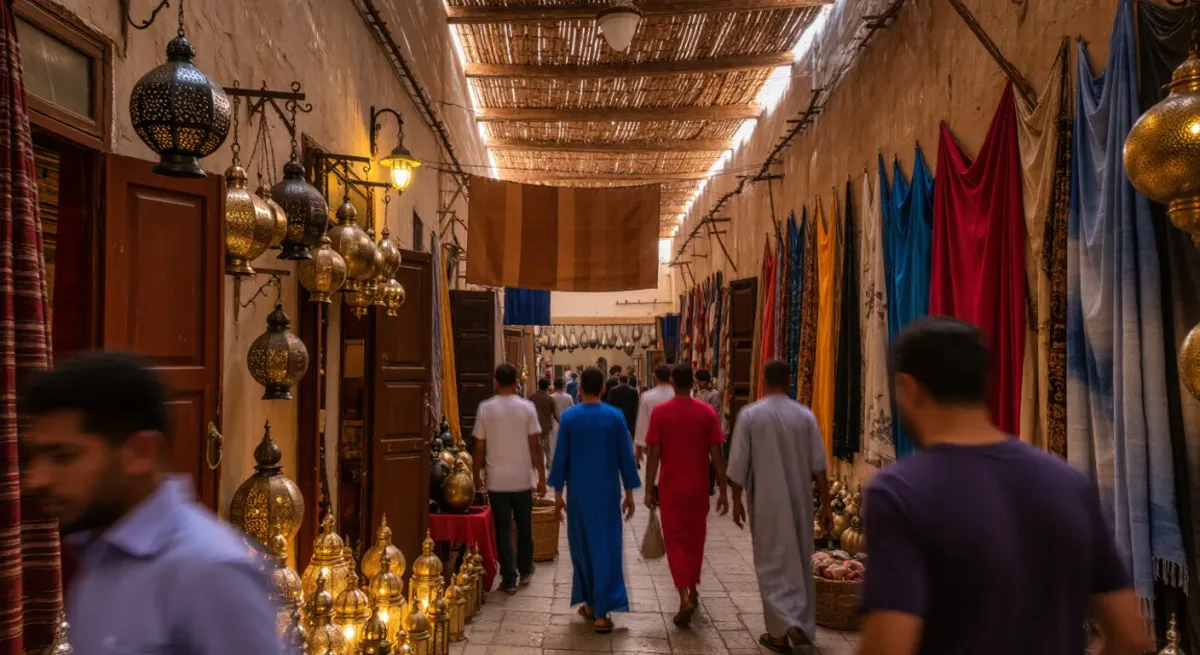
Souk shopping runs on comparison and patience rather than fixed prices for handicrafts. Practical rules that hold up: compare the same item at three stalls before discussing price, treat the first quoted figure as an opening position rather than an insult, and agree on a number before any wrapping or customization starts. Fixed-price enclaves exist, notably the government-backed craft cooperatives for carpets and argan oil, where receipts and export paperwork are available. Leather goods remain the category with the widest quality spread; the tanneries themselves can be visited from viewing terraces, an experience that is pungent in summer and inauthentic nowhere. Say no, quietly and repeatedly, to unsolicited guides at the gates; licensed guides are hired through recognized agencies and carry identification.
Jemaa el-Fnaa after dark
The square changes shift at dusk. Through the day it holds orange-juice carts and a spreading informal market; from late afternoon the food stalls grid assembles at its center, storytellers and gnawa musicians work the edges, and rooftop cafes ringing the square fill for the view of all of it. Eating at the numbered stall rows is inexpensive and busy; the fixed-price items are posted, and shellfish and escargot stalls have their own followings. The rooftop cafes charge a premium precisely for the panorama and stay open latest.
Where to stay and what it costs
Riads, traditional courtyard houses converted to small hotels, dominate medina accommodation, and they concentrate value: doubles from roughly 60 to 90 euros at the comfortable end of mid-range, with breakfast on the roof included as standard. Cars cannot reach most riad doors, so arrivals involve a short walk with luggage porters; ask the riad in advance where to be dropped and whether they send someone to the nearest car-accessible point. A full budget breakdown, from street food to hammam sessions, sits in our companion piece on what a week in Marrakech actually costs.
Seasons and timing
Marrakech is a plain city at the foot of the Atlas, which makes its seasons matter more than visitors expect. October to April is the comfortable core: 20 to 26 degrees by day in the shoulder months, cool nights, and peak crowds from late October through March, plus a sharp spike around the December holidays. From May the city heats up, July and August regularly exceed 40 degrees, and sightseeing shifts to the 8-to-noon and after-5 pattern. Ramadan compresses daytime food service; many riads continue serving breakfast to guests privately while public cafes open at sunset. The best practical dates for combining the medina with Atlas or coast trips are late March to early May and October to mid-November, before either heat or the December price surge.
Half-day and full-day plans
For travelers with only a half day, the workable core is Ben Youssef Madrasa at opening, a structured wander south through Souk Semmarine to Jemaa el-Fnaa, one palace, Bahia is closest to the souk spine, and the square at dusk from a rooftop cafe. A full day adds the Saadian Tombs and El Badi in the morning, the northern medina's Le Jardin Secret after lunch, and the evening back at the square for the food stalls. Two comfortable days split east and west of the souk spine and move Majorelle to the early morning of day two, before the garden's queues form; it sits outside the walls, so a petit taxi or the short walk from the Guéliz edge both work. Guides are worth hiring for the first morning only: the medina's logic, main dris plus landmarks, clicks quickly, and self-guided afternoons are the norm rather than the compromise.
For the wider picture, including Morocco beyond Marrakech, browse the travel and heritage section.