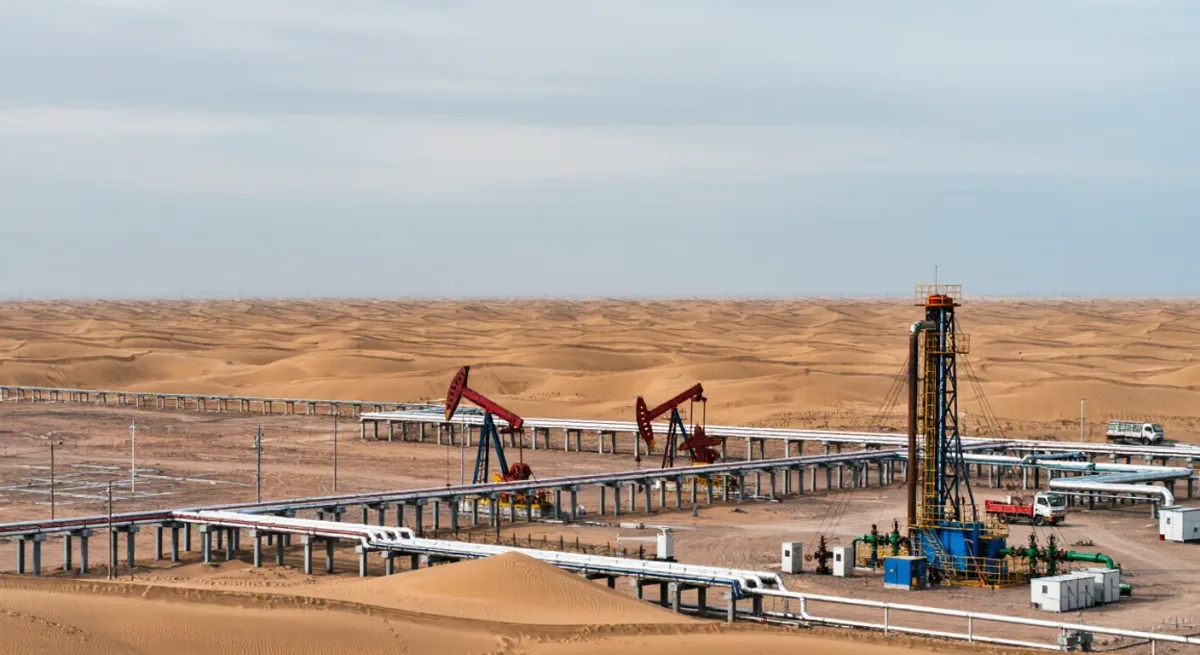
OPEC+ agreed on March 1 to raise production by 206,000 barrels per day from April, an increase of deliberate modesty taken at the group's first meeting since the war in the Middle East opened with strikes on Iran and Iran's declaration closing the Strait of Hormuz. The eight core producers, Saudi Arabia, Russia, Iraq, the UAE, Kuwait, Algeria, Kazakhstan and Oman, resumed the unwinding of their 1.65 million-barrel-per-day voluntary cut tranche after a pause that had held output flat through the first quarter (OPEC press release, March 1, 2026; Reuters).
The size of the decision was the story. Delegates had debated options ranging from around 137,000 barrels per day to larger additions, per Reuters' meeting-day reporting, and the group settled on a figure that acknowledges the supply shock without pretending to fill it: the strait's disruption runs at multiples of anything OPEC+ spare capacity can offset, and most of that spare capacity itself sits in Gulf exporters whose loading terminals sit inside the closed waterway.
The arithmetic of the moment
The group's position entering March was already unusual. Through 2025 the eight producers had returned roughly 2.9 million barrels per day of the 2.2-million tranche-plus-baseline volume to the market in monthly steps since April 2025, and the November 30, 2025 meeting had paused further increases for the first quarter of 2026, a caution widely read as price defense amid soft demand signals. The war inverted the context within a single day: the question at the March 1 session was no longer whether to add barrels into a soft market but how much to add into a disrupted one, and the answer, 206,000 barrels, is roughly one percent of the volume the strait carries.
| Decision | Detail |
|---|---|
| April 2026 increase | +206,000 b/d, eight core producers |
| Tranche remaining | Most of the 1.65 million b/d voluntary cuts stay in place |
| Prior context | Q1 2026 pause agreed November 30, 2025 |
Why not more
The constraint is geographic before it is political. Genuine spare capacity, production that can rise within weeks, is concentrated in Saudi Arabia and the UAE, and their export terminals at Ras Tanura and Fujairah bracket the disrupted waterway; the UAE's Fujairah pipeline reaches the Indian Ocean side, which gives its barrels a route around the strait, but Saudi volume through Yanbu on the Red Sea is limited by pipeline capacity. Producers outside the Gulf core, Russia above all, pump near capacity already. A maximal increase would therefore have been a paper gesture, and the group's statement paired the April figure with the standard formula that the remaining tranche may be returned in part or in whole, or paused, according to prevailing conditions, language that preserves every option for the April meeting.
The demand-side caution
The second reason for restraint runs the other direction. A supply shock of this scale is also a demand shock in formation: oil near 120 dollars acts as a tax on every importing economy, and the group's own economists have spent the cycle warning that price spikes destroy the demand their barrels serve. Chinese and Indian refiners, the largest takers of Gulf crude, face the rerouting costs and the political questions of wartime sourcing simultaneously. The 206,000-barrel step reads as the group's attempt to hold both books at once, supportive of a market short of barrels, restrained in a way that does not accelerate the demand destruction that would punish its own members' long-run volumes.
What it means for the weeks ahead
Market attention now moves to the physical evidence: whether April loadings from Gulf terminals actually decline by the closure's arithmetic, how quickly storage outside the strait draws, and which importers release strategic stocks, moves by consumer-government stockholders that historically accompany price episodes at this scale. Within OPEC+, the April meeting becomes the next checkpoint on the tranche's fate, and the group's capacity-mechanism work, the formal effort to establish each member's credible maximum output, resumes a new relevance: in a war-shaped market, the question of who can really add barrels is the only one that matters.
The group's wartime mechanics
The war has forced the cartel's machinery to operate under conditions it was never designed for, and the adaptations are visible in the communiques. Meetings shortened and moved online entirely, decisions announced on the same day as the sessions rather than leaking through the Vienna correspondent corps. The compensation schedule, the ledger by which overproducing members owe future restraint, gained new weight as members with damaged export routes produced for domestic need against quotas written for peacetime. The declaration's standard market-stability language was joined by formulations about supporting the global economy through disruption, a framing that lets the group present restraint or increases as the same virtue depending on the month. And the group's data dependencies degraded: the secondary-source production estimates the quotas reference, compiled from trackers and validators, now measure a market where tankers wait, transits reroute and storage fills outside the survey's reach, so even the compliance arithmetic runs on noisier numbers than the pre-war years. None of this broke the machinery; all of it raised the premium on reading the group's actions rather than its words, which is where this article's analysis will keep its attention.
The April meeting, the first full session after the March decision, becomes the test of whether the pause-era cadence hardens into the year's pattern.
For the market context that produced this decision, read our report on the strait closure and the oil price surge, and follow the energy section for continuing OPEC+ coverage.