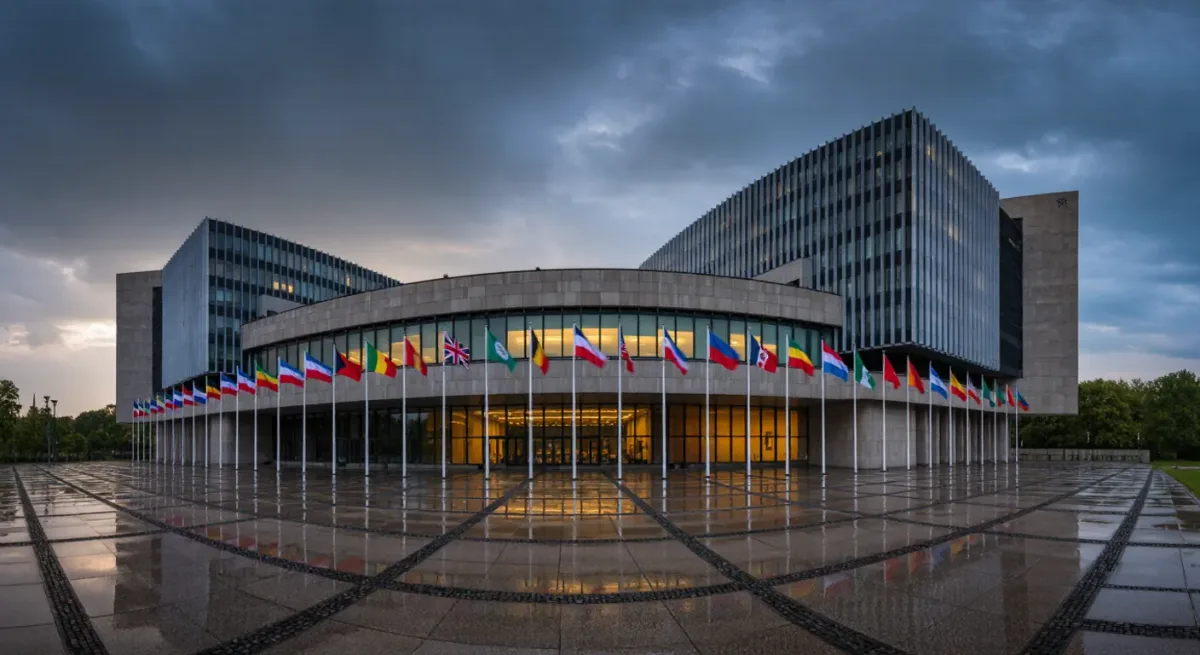
What is OPEC+? It is a coalition of the Organization of the Petroleum Exporting Countries and a group of non-OPEC producers led by Russia that jointly manages oil supply through agreed production targets. Founded in its current form by the 2016 Declaration of Cooperation, the group's decisions, taken at meetings in Vienna, directly shape the supply side of the world oil price, and its core members include Saudi Arabia, Russia, Iraq, the UAE, Kuwait, Algeria, Kazakhstan and Oman.
The plus matters as much as the acronym. OPEC itself, founded in Baghdad in 1960 by Iran, Iraq, Kuwait, Saudi Arabia and Venezuela and headquartered in Vienna, spent its first half-century as a producers' club of developing states. The 2014-2016 price collapse, driven partly by North American shale supply, pushed the cartel into a formal alliance with Russia and other non-members, and since 2016 the expanded group has functioned as the market's swing committee, cutting collectively when prices fall and returning barrels when markets tighten.
How the machinery works
OPEC+ operates through production targets: each member state receives a quota, expressed in barrels per day, and the sum of quotas is the group's supply stance. The full group meets periodically, typically by video conference monthly for the core producers, with the Joint Ministerial Monitoring Committee, a smaller sub-set of ministers, reviewing compliance and market conditions between sessions. Because OPEC has no enforcement mechanism beyond consensus, the system runs on production surveys and diplomacy: overproduction by one member is a standing agenda item, and the group's credibility rises and falls with the market's belief that quotas stick.
The quotas are layered, which is the detail that confuses newcomers. On top of the baseline group-wide cuts sit the voluntary cuts, a tranche of around 1.65 million barrels per day held by eight core producers, and a second tranche of around 2.2 million barrels held largely by the same group, layered on the reference production baselines set in successive agreements. When the group tightens, it deepens these tranches; when it loosens, it returns them in monthly increments. Group-wide decisions also come with the capacity-mechanism work the group has used to formalize each member's sustainable maximum output.
The cuts-and-returns decade
The recent cycle shows the mechanism clearly. Facing the pandemic's demand collapse, OPEC+ cut nearly 10 million barrels per day in 2020, then unwound the cuts slowly as demand recovered. From 2022, the group pivoted to supporting prices, announcing successive production cuts that October and deeper voluntary cuts through 2023. From April 2025, the eight core producers began returning barrels in monthly increments, unwinding the 2.2 million tranche through 2025, and the group then paused and resumed the schedule as market conditions shifted, including the pause on increases announced for early 2026. Each step moved global supply by hundreds of thousands of barrels per day, and each was priced into crude futures within minutes of the announcement.
| Layer | What it is | Scale |
|---|---|---|
| OPEC founding | 1960, Baghdad; HQ Vienna | 12 members |
| Declaration of Cooperation | 2016 alliance with non-OPEC | ~23 countries |
| Voluntary tranche one | Eight-core-producer cuts | ~1.65 million b/d |
| Voluntary tranche two | Deeper 2023 cuts, unwound from 2025 | ~2.2 million b/d |
Why it has power, and its limits
The group's leverage rests on three facts. Its members hold the majority of the world's proven reserves and most of its spare capacity, the ability to add supply quickly, which makes the Gulf core the only supplier bloc that can meaningfully respond to a shock. Its production costs are among the world's lowest, so it can tolerate low prices longer than higher-cost producers. And oil demand is inflexible in the short run, so small supply changes move prices sharply.
The limits are equally structural. The group does not control non-member supply: US shale responds to price signals on its own cycle, and producers from Brazil to Guyana add barrels regardless of Vienna's calendar. Internal cohesion breaks under fiscal stress, as members from Angola, which left OPEC in 2024, to chronic over-producers have shown. And the long-run energy transition caps the strategy's horizon: every member's stated policy includes maximizing the value of reserves while demand lasts, which pulls toward market-share defense and away from indefinite price support.
How to read the meetings
For readers tracking the group, three habits do the most work. Watch the eight core producers, Saudi Arabia and Russia above all, whose pre-meeting commentary telegraphs the decision. Read the quota arithmetic cumulatively, a monthly increase of 200,000 barrels per day matters differently depending on how much of the voluntary tranches remains unwound. And separate the decision from the rhetoric: the group's statements always cite market stability, and the interesting information is in the numbers, the schedule, and the compliance data that follows in the monthly reports.
A short glossary for the communiques
The group's statements reward fluency in a small vocabulary. Required production levels are the quotas themselves, the barrels each country should produce under the applicable agreement. The compensation schedule is the ledger of past overproduction that members owe as future restraint, a mechanism that converts cheating into scheduled repayment. The JMMC reviews compliance and reports to the full conference; the ONOMM, the group's ministerial sessions, make the decisions. Voluntary adjustments are the layer the eight core producers added on top of group-wide cuts, precisely the layer whose return has paced the market since 2025. The capacity mechanism, formalized in the group's recent practice, audits members' sustainable maximum output, the number that will matter most when baselines are renegotiated. Reference crude baselines, the production reference points from which each member's quota is calculated, are the whole game's load-bearing wall, and every member knows it: when a communique mentions reviewing them, the market is being told that the cartel's internal bargain is back on the table.
For how those decisions translate into the prices consumers and airlines actually pay, read our companion explainer on oil benchmarks from Brent to Murban, and browse the energy section for the region's power and petroleum coverage.