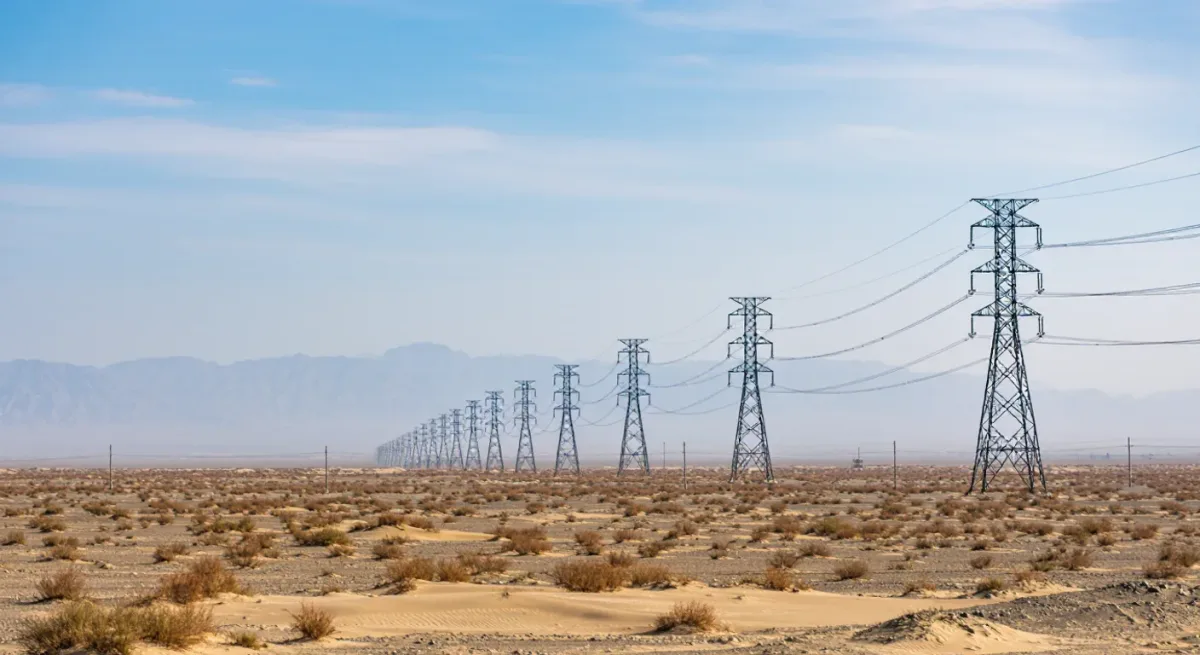
The Middle East and North Africa is stitching its national electricity systems into a lattice of interconnectors, and the engineering is already older and larger than most coverage implies. The Gulf Cooperation Council's interconnected grid has shared backup capacity between the six states since 2009; the Egypt-Saudi Arabia HVDC link, sized around three gigawatts, is the newest major addition; and the Morocco-Spain submarine cables have carried power across the Mediterranean for decades, with more capacity planned. Interconnection is the region's quietest large infrastructure program.
The GCC supergrid
The Gulf's system, operated by the GCC Interconnection Authority from Dammam, linked the six member states' grids in phases starting in 2009, with Saudi Arabia and Kuwait completing the last major stage in 2020. The engineering spine is a 400-kilovolt alternating-current network with back-to-back converter stations where system frequencies differ, Saudi Arabia's 60-hertz grid against the 50-hertz systems of its neighbors. The founding logic was reliability: each state had to build generation reserve for its own worst day, and sharing reserve across borders let every participant carry less idle capacity for the same security. The system has carried actual emergency support between systems in summer peaks since, and the authority has been expanding its mandate toward electricity trading proper, letting surpluses be sold across borders rather than only held as mutual insurance.
Egypt-Saudi: the newest big wire
The Egypt-Saudi Arabia interconnection, contracted to a consortium including Hitachi ABB Power Grids and Orascom and Saudi entities in 2021 at roughly 1.8 billion dollars, connects Badr in Egypt to Medina in Saudi Arabia through the Sinai and the Gulf of Aqaba with high-voltage direct-current converters at roughly 3,000 megawatts of transfer capacity. Its commissioning has been announced in stages, and its commercial logic is the region's sharpest: the two countries sit in opposite peak regimes, Egypt peaks in summer afternoons on air conditioning, the kingdom's own summer peak is even more extreme, while seasonal and daily surpluses differ enough to trade. Saudi Arabia holds the Gulf system on one side of the wire and Egypt the Arab-world's largest single grid on the other, which turns the project into the hinge between the GCC supergrid and the Levant-North Africa systems for the first time.
| Link | Capacity | Status |
|---|---|---|
| GCC supergrid (six states) | Shared reserve, 400 kV | Operating since 2009; Saudi-Kuwait stage 2020 |
| Egypt-Saudi HVDC | ~3,000 MW | Contracted 2021, commissioning in stages |
| Morocco-Spain | ~700 MW growing toward ~1.4-2.1 GW | Operating; third link planned |
| Gulf-Iraq (GCCIA-Baghdad) | First phase ~500 MW | Connected in stages from 2021-2024 |
The Mediterranean crossings
The Maghreb's interconnections are the oldest in the region and run north, not east. Morocco and Spain have exchanged power through submarine cables since the 1990s, with the present interconnection capacity near 700 megawatts and a third link under development to lift capacity further, plumbing that makes Morocco the only MENA power system synchronized with Europe and the reason its renewable exports and grid services are commercially interesting to the Iberian market. Tunisia-Italy's planned ELMED link, around 600 megawatts, extends the same logic eastward, and the Egypt-Cyprus-Greece EuroAfrica interconnector proposal would carry Egyptian solar and gas-fired power toward Crete. Each of these projects couples MENA supply curves to European prices, which is the structural point of the whole Mediterranean lattice.
What interconnection is for
Four functions recur across every one of these projects. Reliability reserve: shared backup capacity, the GCC founding purpose, worth billions in avoided idle plants. Trading: selling surpluses across borders on daily and seasonal cycles, which the Egypt-Saudi link institutionalizes. Renewables absorption: a solar peak in one system meeting an evening peak in another is the cheapest storage there is, and the wider the synchronous area, the more variable generation it carries without curtailment. And political economics: every interconnector is a physical alliance, the Gulf-Iraq links built alongside security relationships, the Mediterranean cables negotiated inside energy-partnership frameworks with Brussels.
The constraints
The obstacles are institutional, not technical. Electricity trading requires harmonized market rules, and the region's systems run under different regulators, tariffs and subsidy regimes; the GCC's trading ambitions have moved at the pace of those alignments, not the pace of the wires. Payment certainty constrains links into deficit systems, as Egypt's gas arrears history illustrates by analogy. And conflict damage is now part of the risk register: regional escalation since early 2026 has added physical-security insurance questions to projects crossing exposed geography, a fact that pricing agencies and reinsurers now treat as part of MENA infrastructure finance. None of this has stopped the build-out; it has priced it.
How to follow it
- GCCIA announcements track Gulf trading stages and the Iraq extensions.
- Egyptian and Saudi ministry releases mark the HVDC link's commercial operation dates.
- Spanish and Moroccan grid operators publish the Mediterranean interconnection's flows and the third-link schedule.
- Market-rule news, regulator harmonization and trading platform launches, is the leading indicator for when the wires carry trade rather than insurance.
The trading regime still being built
The gap between wires and markets is the region's institutional frontier. The GCC system's founding treaty provided for reserve sharing and settlement between states, and the authority has since piloted weekly auctions for cross-border capacity, the embryo of a Gulf power pool; the day-ahead and intraday products that European traders take for granted exist in the Gulf only as roadmaps. Egypt-Saudi will settle exchanges under a bilateral agreement whose pricing formula, peak-season power for off-peak, encodes the two systems' complementary load curves. The Mediterranean links run on merchant and inter-TSO arrangements under EU-adjacent rules, Morocco's interconnector revenue already a line in the kingdom's utility accounts. The prizes are quantified in the planners' studies: every gigawatt of interconnection displaces reserve capacity worth hundreds of millions in avoided investment, and the solar belt's daytime surplus to the north and east is, in the models, the cheapest decarbonization the region can buy. The wires exist; the market that trades across them is the next decade's work.
For the generation feeding these wires, read our explainer on how OPEC+ manages the region's oil supply, or see the energy section for the full picture.