Saudi Arabia's civil nuclear program is the region's largest energy plan that has not yet turned into construction. The kingdom's stated ambition, anchored in its Vision 2030 planning documents, runs to roughly 17 gigawatts of nuclear capacity by 2040, served by large light-water reactors plus small modular reactors, with a research-and-development base already operating. What exists on the ground today: a research reactor and nuclear infrastructure in Riyadh, a nuclear regulator, and a tender process for the first two large reactors that has run, unresolved, for most of a decade. No commercial plant is under construction.
What is actually built
The physical core of the program sits with King Abdullah City for Atomic and Renewable Energy, K.A.CARE, the planning authority created in 2010, and the King Abdulaziz City for Science and Technology, whose low-power research reactor in Riyadh, a Chinese-supplied design, began operation in the past several years. The kingdom operates a nuclear regulatory body with IAEA-benchmarked frameworks, has an IAEA Country Nuclear Power Infrastructure Infrastructure assessment history, and sends the region's largest atomic-energy scholarship pipeline abroad. These are the real assets: institutions, fuel-cycle knowledge, and a cadre of trained engineers, not gigawatts.
The big-reactor tender, and why it never closed
The first commercial project, two large reactors at a coastal site on the Gulf, has been tendered since 2017, with the candidate consortium well-known: Korea Electric Power with its UAE-delivered APR1400 record, EDF of France, Rosatom of Russia, China National Nuclear Corporation, and Westinghouse of the United States. The tender's sticking points have been structural. The kingdom has sought co-location of fuel-cycle elements and technology transfer that US vendors' 123 Agreement conditions complicate, since Washington and Riyadh have never concluded the nuclear cooperation agreement that would let American vendors export reactors; Chinese and Russian bids face geopolitical screens; and financing terms for a multi-tens-of-billions first-of-a-kind program remain the decisive commercial variable. Reporting through recent cycles has repeatedly had the kingdom close to a Chinese-preferred or Korean-preferred decision, and repeatedly without a signed engineering contract.
| Element | Status |
|---|---|
| Vision 2030 nuclear target | ~17 GW by 2040 |
| Research reactor, Riyadh | Operating |
| Regulator and legal framework | Established, IAEA-benchmarked |
| First two large reactors | Tender open since 2017, no EPC signed |
| Small modular reactors | Cooperation agreements, no deployment |
The UAE comparison, which frames everything
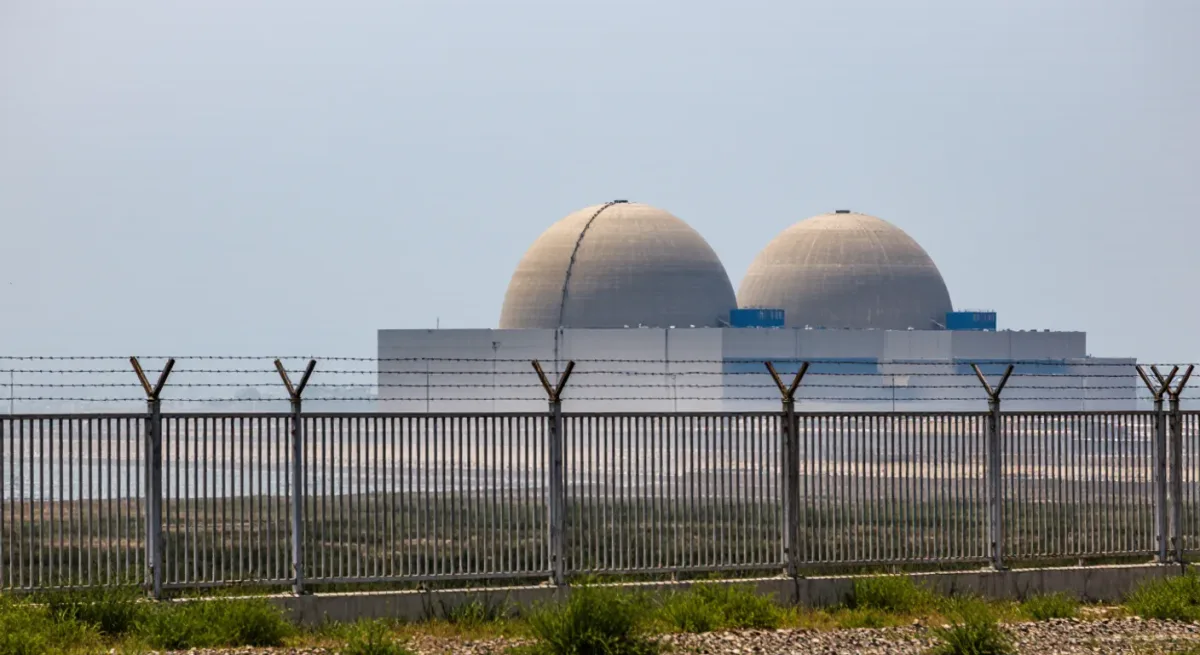
The Barakah plant in the Emirates, the Arab world's first commercial nuclear station, is the program's shadow and its argument. Four Korean APR1400 reactors at Barakah, contracted in 2009 and delivered across the 2020s, now supply a meaningful share of UAE electricity around the clock, carbon-free, after a program that ran roughly a decade late. Barakah shows the Gulf can do nuclear: it also shows the prerequisites Riyadh lacks, a concluded 123 Agreement with Washington for US-origin components, a single-vendor turnkey structure, and a tolerance for delay that the Saudi program's political economy has not yet accepted. The Emirati precedent is why the Korean consortium is widely considered the technically proven route for Riyadh's first pair.
Why the kingdom wants it
The demand case is the strongest card. Saudi electricity demand is growing at rates that strain the gas allocation, every barrel of crude or million cubic feet of gas burned in power generation is an export foregone, and the summer air-conditioning peak arrives exactly when export margins are richest. Nuclear baseload competes with solar-plus-storage and with gas on levelized terms for that peak-shaped system, and the kingdom is building all three in parallel, solar at record pace, gas from its unconventional program, nuclear pending. The industrial argument, jobs, localization, a seat at the civil-nuclear technology table, carries at least equal weight in the official framing, and the hydrogen-era framing, reactors as clean molecules' heat source, extends it.
The constraints that travel with it
- Nonproliferation policy: the absence of a US-Saudi 123 Agreement constrains vendor choice and fuel-cycle scope; IAEA safeguards apply regardless.
- Financing: a first pair of large reactors is a sovereign-scale balance-sheet item in an era of competing giga-projects.
- Human capital: operating fleets need cadres the kingdom is still building; the scholarship pipeline is the program's most genuine progress.
- Alternatives: solar's cost collapse keeps raising the bar that nuclear baseload must clear in the Kingdom's own auctions.
How to read the next announcement
The program's news flow rewards skepticism calibrated to the pattern: site preparation, memoranda, and vendor-delegation photo opportunities are routine; a signed engineering, procurement and construction contract with financing close is the event that would actually change the region's energy map. Until that signature, the honest description of Saudi nuclear ambition is the one this article opened with, institutions and intentions built out, steel not yet rising.
The questions a decision would answer
A signed first contract would settle, at a stroke, four questions the region's energy planners have held open for a decade. Vendor politics: whether Washington's 123 Agreement path, the Korean turnkey route proven at Barakah, or a Chinese offer wins, a choice that sets the program's geopolitical alignment for its whole life. Scale: the first pair's size, financing structure and grid integration answer whether the 17-gigawatt target is a plan or an aspiration. Fuel cycle: where enrichment and fabrication sit, the nonproliferation question the IAEA safeguards conversation will have adjudicated. And industrial policy: which local content, training and operations commitments ride on the contract, the numbers that decide whether the program builds a Saudi nuclear industry or imports one. Until signature, each question keeps its multiple answers, which is why every rumor of a decision moves reporting: the region's energy map has a kingdom-sized hole in it, and everyone can see the shape. The honest forecast remains the one this article opened with, that the announcement is always one summit away, and has been for almost a decade.
For the kingdom's build-out that is already in steel and glass, see our guide to the Gulf's solar mega-projects, and browse the energy section for the region's power coverage.