The Arabic-language and wider MENA film year now runs on a fixed circuit of festivals with dates a traveler or industry professional can plan around: Carthage and El Gouna in October-November, Cairo in November, Marrakech in late November or December, and Jeddah's Red Sea International Film Festival in early December, with documentary and short-film slots filling the shoulder months. Each festival has a distinct mandate, and the circuit as a whole has become the primary distribution ladder for Arab and African cinema outside the European co-production system.
The season, in order
| Festival | City | Usual window | Running since | Focus |
|---|---|---|---|---|
| Carthage Film Festival (JCC) | Tunis | Oct-Nov | 1966 | Arab and African cinema |
| El Gouna Film Festival | El Gouna, Egypt | October | 2017 | International program, Arab focus |
| Cairo International Film Festival | Cairo | November | 1976 | Oldest major festival in the region |
| Marrakech International Film Festival | Marrakech | Nov-Dec | 2001 | Auteur premieres, Gulf-financed gloss |
| Red Sea International Film Festival | Jeddah | December | 2021 | Arab and African films, industry market |
| Ismailia Documentary Festival | Ismailia, Egypt | June | 1979 | Documentaries and shorts |
Carthage: the elder
The Journées Cinématographiques de Carthage, founded in Tunis in 1966, is the oldest festival in the circuit and the one with the clearest political genealogy: created in the decade after independence as a pan-Arab and pan-African platform, it runs the Tanit awards for films from the two regions and remains the circuit's gateway for African cinema heading toward the wider market. Its dates sit in the Tunisian autumn, and its venues string through central Tunis with screenings priced for local audiences, not badge holders.
Cairo and the November anchor
The Cairo International Film Festival, running since 1976, is the Arab world's longest-established internationally rated festival and the anchor of the region's November. Its industry arm co-production platforms, which have moved between editions but consistently serve Arab projects, give it a market function beyond the screenings. El Gouna, the Red Sea resort town's festival founded in 2017, added a second Egyptian slot in October with a stronger resort-industry economy behind it, and the two Egyptian festivals effectively bracket the autumn for Arab premieres.
Marrakech and the Red Sea: the new power centers
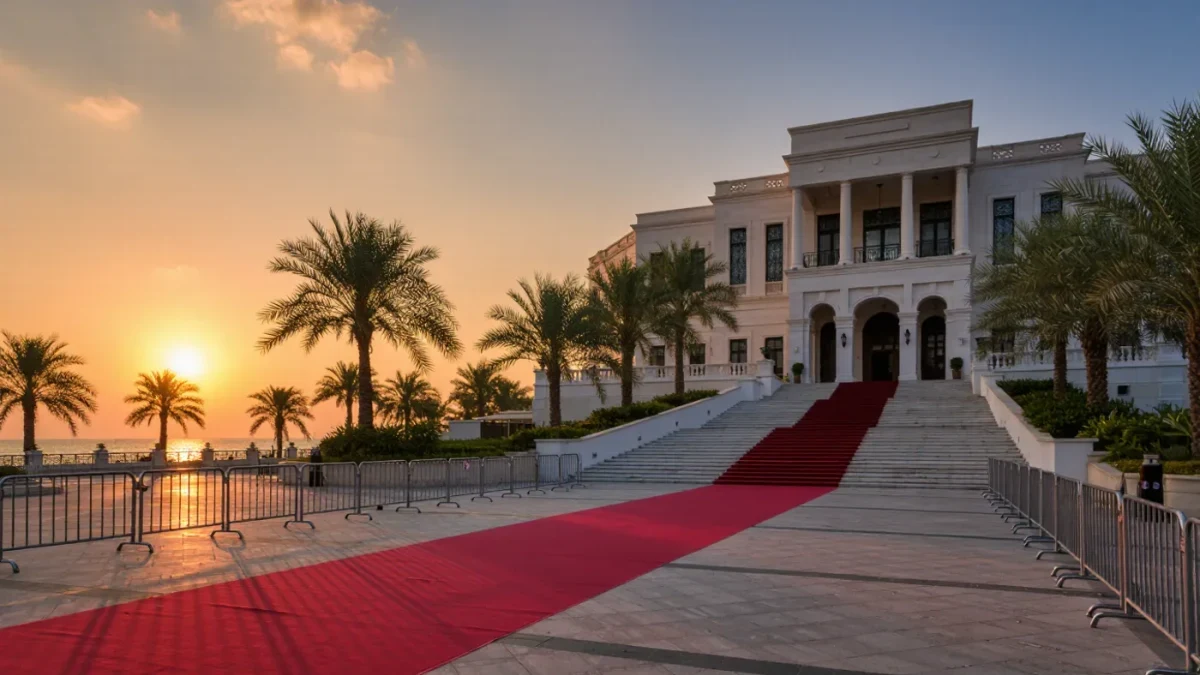
The Marrakech International Film Festival, founded in 2001, built its identity on starry international premieres and a Moroccan state tourism economy, and its late-year slot has made it the circuit's most visible red carpet. The Red Sea International Film Festival in Jeddah, first held in December 2021 after Saudi Arabia lifted its decades-long cinema ban in 2018, is the youngest and now among the most consequential: backed by the kingdom's culture fund apparatus, it runs an industry market alongside the festival, screens a large Arab and African slate, and its foundation finances development and post-production across the region. Between them, the two festivals have pulled the circuit's commercial center of gravity toward the Gulf and Morocco in the space of a few years.
What the circuit does for the films
The ladder works in a recognizable sequence. An Arab feature premieres at Carthage, Cairo or the Red Sea, gathers festival citations, and uses that record for streaming sales and European distribution, with the Red Sea's fund and the Cairo and Marrakech co-production platforms feeding development. The major streaming platforms now acquire at these festivals directly rather than waiting for European market debuts, and Arab-language originals on global platforms are routinely traceable to a festival-world première in the circuit. The festivals are also the region's main industry employer for below-the-line craft, since market sidebars run masterclasses and co-production matchmaking that function as de facto training and financing infrastructure.
Going, practically
- Accreditation: industry passes open two to three months before each edition; press and guest categories differ by festival.
- Public tickets: Cairo, Carthage and Ismailia sell to the public cheaply; Marrakech and the Red Sea run a mix of public sales and invitation events that sell out within hours.
- Timing: the October-December window is the circuit's core; book Jeddah and Marrakech accommodation early, as both cities price up sharply around their festival weeks.
- Language: screenings run in original languages with Arabic, French or English subtitles depending on the festival; industry events are predominantly English.
The funding layer behind the calendar
The circuit's financial plumbing explains its geography. The Red Sea Film Festival Foundation operates both the December festival and a development fund that finances Arab and African projects at script and post-production stages, recycling Gulf capital into the independent cinema the festivals screen. Cairo's co-production platform and Marrakech's Atlas Workshops perform the same midwifery for films that arrive as projects and leave with partners attached. The European and global funds, from the continent's co-development schemes to the streaming platforms' regional originals budgets, treat a festival world premiere as the qualifying signal for acquisition, which makes the October-December corridor the year's deal window as much as its prestige season. For filmmakers, the strategy this architecture suggests is standard: build the film's financing in layers keyed to festival milestones, premiere where the region's buyers and funds convene, and use the citations as currency for the wider market. For audiences, it is why the same cluster of names reappears across the autumn's programs, and why the first screenings function as the industry's audit of its own pipeline.
One practical footnote: accreditation windows and submission deadlines for the autumn festivals cluster between May and July each year, so the professionals you see on the red carpets in December locked their plans a full season earlier.
For the region's other major public-facing cultural calendar, the museum openings reshaping Gulf and Egyptian tourism, read our companion guide to MENA's grand museums, or browse the society and culture section.